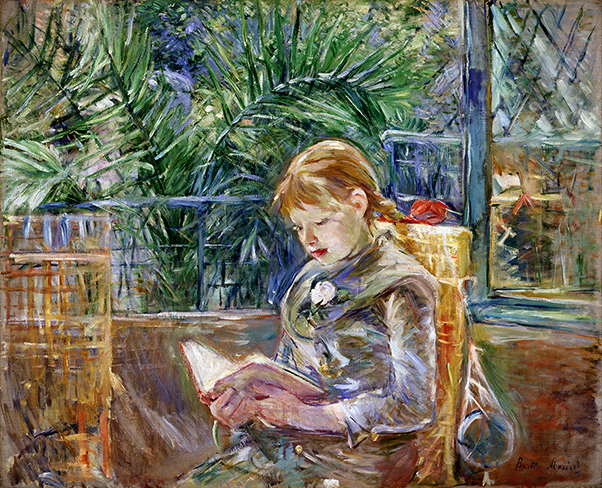
In Berthe Morisot's La Lecture, painted in 1873, a young woman sits with her head bent over a book. She is not posing. She is elsewhere — absorbed, concentrated, unreachable for the moment. If you didn't notice the book in her hands, you might think she was looking at a phone.
The painting is small. The woman's face is barely visible. What Morisot captures is not a portrait — it is a posture. The specific angle of the body when reading takes hold.
Alberto Manguel opens his History of Reading with a scene in a forest: a boy sitting on a mossy log, holding a small book, master of time and space. The image is from a medieval illumination, but it could be from any century. The posture is always the same.
We are all readers. Even people who say they don't read. The commuter scanning headlines. The cook following a recipe. The mechanic tracing a wiring diagram. We belong, all of us, to the oldest community there is — those who make sense of marks on a surface.
The library and the bookshop exist because of this community. That feeling of walking in and knowing you belong — it is not sentimental. It is recognition of a shared practice that goes back further than any living institution.
Reading is not passive reception. It produces something. When you read a novel, you construct an interior world — faces, rooms, the weight of a season. No two readers build exactly the same one. The text is the same; the universe it generates is yours.
A novel teaches you to inhabit other minds. To think socially — to understand how a person becomes who they are under specific pressures, in specific places. The reader of novels becomes, over time, better equipped to understand human complexity. Not because they were taught. Because they practiced.
We called it code.
Of all the names available — instructions, scripts, writing, notation — we chose the one that means encrypted, locked, for initiated eyes only. There are hundreds of books about "algorithms" written by people who have never opened a terminal. The word has become an abstraction, a myth, a thing that happens elsewhere by people unlike you.
This naming is not an accident.
The history of writing is a history of power organized through symbols. Every civilization that developed writing developed, alongside it, a class of people who controlled it — scribes, monks, copyists — and an institution to protect that control. The medieval church did not just save souls. It determined what was written, what was copied, what was destroyed. Truth was in the manuscript. The monastery was the server farm.
The programmer is the modern copyist. The resemblance is not metaphorical — it is structural. The sacred texts of documentation, the high priests of the operating system, the popes of the platform. The power structure of the tech industry looks exactly like what has always happened when writing concentrates into the hands of a guild and the guild becomes an institution.
Now the copyist is being retired. AI writes code faster than any human, in any language, on demand. What remains — what cannot yet be automated — is the reading. The judgment. The eye that knows whether a line is right or wrong, elegant or dangerous, honest or full of hidden debt.
This is not a small thing. It is, in fact, the whole thing.
Experienced developers have a term for bad code: code smell. When something at the surface seems off, there is always more underneath. Like any text, code has style. And like any text, great work is great at the sentence level — always, without exception. Take any page from a great novel and the prose holds. Take any function from great software and the logic holds.
Hemingway spent his life trying to use fewer words. So did the best programmers.
But reading code is not only reading style. It is reading the instructions that run the world.
McLuhan argued that every medium is an extension of the human nervous system. The telephone extends the voice. The network extends the central nervous system itself — a global infrastructure of signals, responses, feedback loops. Code is what that nervous system is written in.
To read code is to read in systems. The way a novel teaches you to think socially, code teaches you to think structurally — in networks, loops, recursion, in the logic of things that scale. These are not computer concepts. They are patterns that appear everywhere, once you have learned to see them.
There is a persistent myth that this kind of reading is purely intellectual — cold, logical, a taste acquired only by a specific type of person. It is not.
There is no discovery without desire. No recognition without some prior curiosity that has been looking for a place to land. The fear that code is not for you and the certainty that you won't understand it are the same fear. They reinforce each other. They close the door from the inside.
But desire, once admitted, changes things fast. The satisfaction of suddenly understanding a concept in a philosophy book — that click of recognition — is the same thing that happens when a piece of code becomes readable. The same nervous system. The same pleasure.
The history of code is full of people who do not fit the current image of who a programmer is. Radia Perlman, who nearly quit her first programming class and went on to write the protocol that still runs in every ethernet switch manufactured since 1990. Vera Molnár, who began making algorithmic art in the 1960s, before personal computers existed, using a machine to explore what a human eye could not see alone. Ada Lovelace, who wrote the first algorithm a century before there was a machine to run it, because the concept interested her.
The field was never closed. It was made to look closed. More ways of writing code can and should exist. They will come from people who learn to read first.
Reading is always the beginning. Before writing, before building, before understanding — there is reading. A posture. A head bent over a page. A moment of concentration that is also a moment of becoming.
The door is open.
Clément Renaud is an artist, social scientist and software engineer. He created sourcereader.org